Modal verbs are six special verbs in German: können, müssen, dürfen, sollen, wollen and mögenThey modify the meaning of another verb and express whether something is possible, necessary, permitted, desired, or intended. A modal verb almost always appears with a second verb in the infinitive form. The modal verb is conjugated, while the second verb remains unchanged and moves to the end of the sentence.
For example: Ich kann Deutsch sprechen. Here is "kann“ the conjugated modal verb and “sprechen"The infinitive at the end of a sentence. In this guide you will learn all six." modalverben including meaning, conjugation and sentence structure, plus mnemonic devices and the most common mistakes.
- There are six modal verbs: können, müssen, dürfen, sollen, wollen, mögen.
- The modal verb is conjugated and is in position 2, the infinitive is at the end of the sentence.
- For all modal verbs, the I-form and the he/she/it-form are identical (I can, he can).
- Not having to means not necessary, not being allowed to means forbidden.
- For polite requests, you use "would like" instead of "want".
What are modal verbs and what do you need them for?
modalverben don't say was you do, but wie You stand behind an action. They indicate possibility, necessity, permission, duty, desire, or will. In German, there are exactly six of them.
- können: ability or possibility (Ich kann schwimmen.)
- müssen: Necessity or coercion (Ich muss arbeiten.)
- dürfen: Permission (Du darfst hier parken.)
- sollen: Order, recommendation or obligation from outside (Du sollst mehr Wasser trinken.)
- wollen: strong will or intention (Ich will Deutsch lernen.)
- mögen: preference or polite request (Ich mag Kaffee.)
Without modal verbs, German sounds very direct. With them, you can politely ask, express plans, and explain rules. That's why they are among the most important verbs.
Sentence structure: where is the modal verb placed?
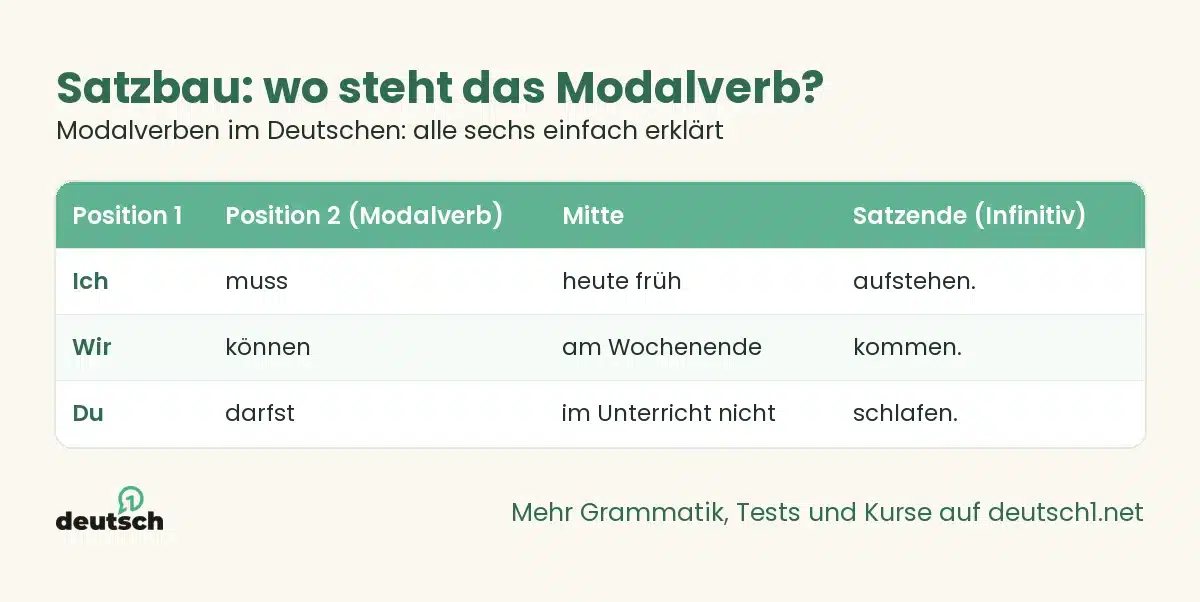
The rule is always the same: The modal verb is in position 2 (in a declarative sentence) and is conjugated. The second verb remains in the sentence. Infinitiv and is located right next to SatzendeThis is called a sentence bracket.
| 1 position | Position 2 (modal verb) | Mitte | Sentence end (infinitive) |
|---|---|---|---|
| Ich | muss | heute früh | aufstehen. |
| Wir | können | am Wochenende | kommen. |
| Du | darfst | im Unterricht nicht | schlafen. |
In yes/no questions, the modal verb comes first: Kannst du mir helfen? In W-questions, the following comes after the question word: Wann musst du gehen?
Important: There is only one conjugated verb per sentence. This is incorrect. Ich kann sprechen Deutsch. Correct is Ich kann Deutsch sprechen. The infinitive must go at the end.

Conjugation in the present tense: the forms of all six
Modal verbs are conjugated irregularly. Notably, the ending is the same in both the first-person (ich) and third-person (er/sie/es) forms; there is no change. -t at the end. Furthermore, the vowel in the stem often changes.
| Person | can | have | allowed | shall | want to spend | mögen |
|---|---|---|---|---|---|---|
| ich | kann | muss | darf | soll | will | mag |
| du | kannst | musst | darfst | sollst | willst | magst |
| er/sie/es | kann | muss | darf | soll | will | mag |
| wir | können | müssen | dürfen | sollen | wollen | mögen |
| ihr | könnt | müsst | dürft | sollt | wollt | mögt |
| sie/Sie | können | müssen | dürfen | sollen | wollen | mögen |
Remember: ich and er/sie/es are always identical. Ich kann, er kann. Ich will, sie will. Only sollen It retains the vowel o in all forms.
Detailed meaning: can, must, may
können Expresses an ability or a possibility.
- Capability: Sie kann sehr gut kochen.
- Possibility: Heute können wir ins Kino gehen.
- Polite request: Können Sie mir bitte helfen?
müssen This means that something is necessary. There is no choice.
- Need: Ich muss morgen früh aufstehen.
- Caution when using negation: nicht müssen This means that something is not necessary (not forbidden). Du musst nicht kommen It means you can come, but it's not necessary.
dürfen expresses permission.
- Permission: Kinder dürfen hier spielen.
- prohibition with nicht: Du darfst hier nicht rauchen. That is forbidden.
The most important difference: nicht müssen = not necessary. nicht dürfen = forbidden. These two are often confused.
Detailed meaning: should, want, like
sollen describes an order, a recommendation, or an obligation that comes from another person.
- Order: Der Chef sagt, ich soll den Bericht schreiben.
- Suggestion: Du sollst mehr schlafen.
wollen shows a strong will or a firm intention.
- Will: Ich will diesen Job haben.
- Plan: Wir wollen nächstes Jahr nach Berlin ziehen.
mögen It expresses a preference and often stands without a second verb.
- Preference: Ich mag Schokolade.
- Polite wish (subjunctive): Ich möchte einen Kaffee, bitte. Form möchte comes from mögen and is very polite. She often takes over in restaurants or while shopping. wollen, weil wollen that sounds too direct.
Tip: Ich will einen Kaffee Sounds demanding. Ich möchte einen Kaffee It's polite. In everyday life, you almost always use it. möchte.
Common mistakes and mnemonic devices
Many learners make these mistakes. If you know them, you can avoid them more easily.
| Wrong | Properly | Why |
|---|---|---|
| Ich kann spreche Deutsch. | Ich kann Deutsch sprechen. | Place the second verb in the infinitive at the end. |
| Er kannt schwimmen. | Er kann schwimmen. | er-form without -t, just like the first-person singular. |
| Du musst nicht hier rauchen. (gemeint: verboten) | Du darfst hier nicht rauchen. | The prohibition is nicht dürfen, not nicht müssen. |
| Ich will ein Wasser, bitte. | Ich möchte ein Wasser, bitte. | möchte is polite will Sounds demanding. |
Mnemonic devices:
- I = he: For all modal verbs, the first-person (ich) form and the second-person (er/sie/es) form are identical. Ich darf, er darf.
- must vs. may negated: Remember the traffic light. Du musst nicht warten This means there's no need to wait. Du darfst nicht gehen That means leaving is forbidden.
- Clamp trick: Modal verb at the beginning, infinitive at the end. Imagine two parentheses holding the sentence together.
If you want to practice this specifically, you can find suitable lessons in the course overview or directly in the B1 course.
This topic is part of the A1 level curriculum. In the online German course A1, you will practice it step by step with explanatory videos, worksheets, and optional homework with feedback.
Frequently asked questions
How many modal verbs are there in German?
There are six modal verbs: können (can), müssen (must), dürfen (may), sollen (should), wollen (want), and mögen (like). Sometimes möchte (would like) is also included, but möchte is actually the polite subjunctive form of mögen.
Where is the modal verb located in the sentence?
In a declarative sentence, the conjugated modal verb is in position 2. The second verb remains in the infinitive and is placed at the end of the sentence. Example: I have to work today.
What is the difference between not having to and not being allowed to?
"Nicht müssen" means that something is not required, so it's allowed but voluntary. "Du muss nicht kommen" means you can come or not. "Nicht dürfen" means that something is forbidden. "Du darf nicht rauchen" means smoking is prohibited.
Why are the first-person and third-person forms the same for modal verbs?
Modal verbs are irregular. Their he/she/it form does not take a definite article. -tTherefore, "ich kann" and "er kann" are identical. This applies to all six modal verbs.
When do I use "would like" instead of "want".
You use "möchte" for polite requests, especially in restaurants or when shopping. "Ich möchte einen Kaffee" sounds polite. "Wohnen" expresses a strong will and can sound demanding: "Ich will einen Kaffee."
