Prepositions in German are small words like in, mit, für or aufThey precede a noun or pronoun and determine the case of that word. First things first: Every preposition requires a specific case. Some always require the accusative case (für, ohne, durch), some always use the dative case (mit, bei, aus), some always use the genitive case (wegen, trotzA special group, the two-way prepositions, sometimes uses the accusative case, sometimes the dative case.
This guide provides you with lists sorted by case, a clear rule for two-way prepositions, and the most common fixed expressions. It includes tables and example sentences that you can repeat directly.
- Every preposition requires a specific case. Always learn them together: mit + dative, für + accusative.
- Accusative-prepositionsFor, without, through, against, in order to. Dative prepositions: from, at, with, after, since, from, to, opposite.
- Two-way prepositions (in, an, auf, über, unter, vor, hinter, neben, zwischen): Where to? = accusative, Where? = dative.
- Genitive prepositions such as wegen and trotz are rather formal and are often replaced in everyday language by von + dative.
- Verbs and adjectives often have fixed prepositions (wait for, be afraid of). You have to memorize these as a set.
German prepositions: What are prepositions and why is the case so important?
Prepositions connect words and indicate relationships: place, time, reason, or manner. They almost always precede the word they refer to.
The crucial point for German learners: A preposition forces the following noun into a specific case. This is called... RektionCompare:
- mit the bus (dative case, because) mit (always requires dative case)
- für the bus (accusative, because für (always requires accusative case)
You see: The word Bus The preposition remains the same, but the article changes. Therefore, you must learn the case along with every preposition. Never learn the preposition alone, but always with its case. mit + Dativ, für + Akkusativ.
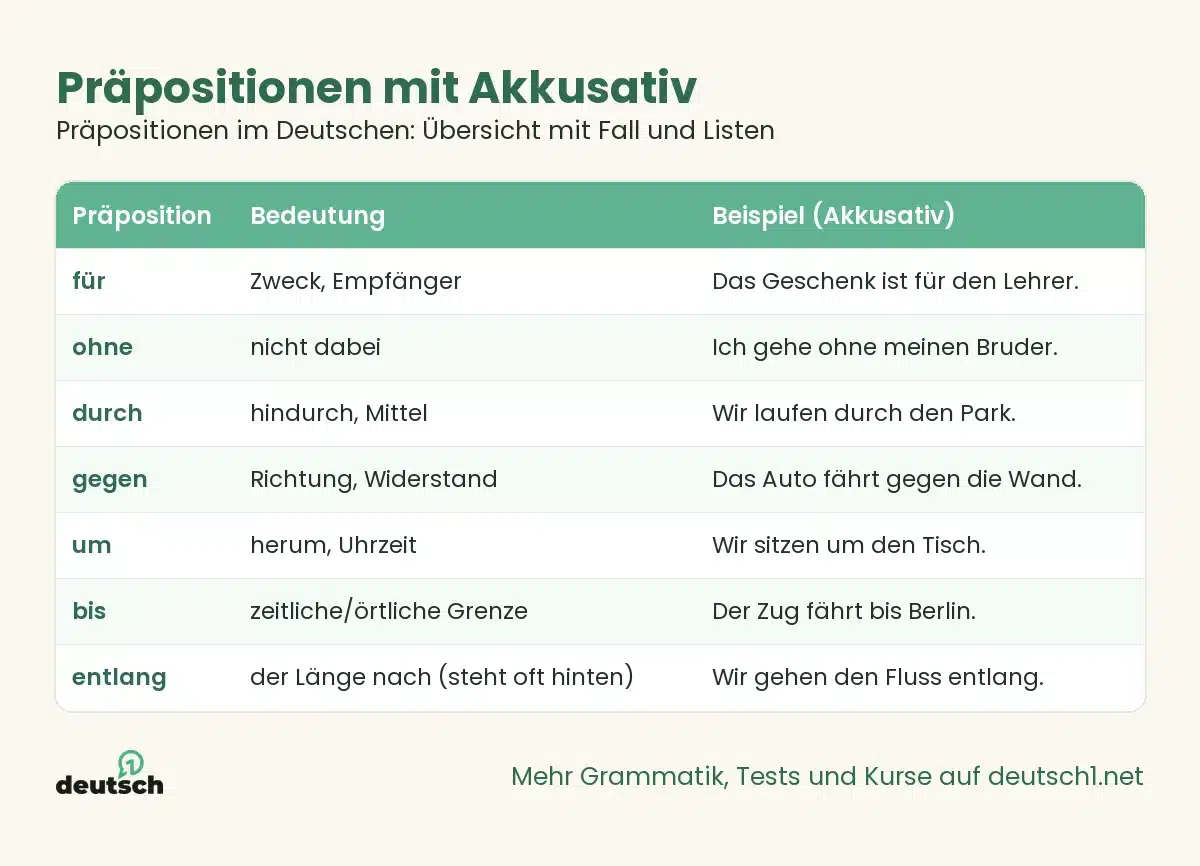
Prepositions with accusative case
These prepositions require immer The accusative case. There are no exceptions.
| preposition | Significance | Example (accusative case) |
|---|---|---|
| für | Purpose, recipient | Das Geschenk ist für den Lehrer. |
| ohne | not there | Ich gehe ohne meinen Bruder. |
| durch | through, means | Wir laufen durch den Park. |
| gegen | Direction, resistance | Das Auto fährt gegen die Wand. |
| um | around, time | Wir sitzen um den Tisch. |
| bis | temporal/spatial boundary | Der Zug fährt bis Berlin. |
| entlang | lengthwise (often at the back) | Wir gehen den Fluss entlang. |
Mnemonic device for the five most important ones: Ffor, Ohne, Dthrough, Gegen, Um. Remember the made-up word FUDGOU or the sentence “Für ohne durch gegen um“ as a fixed series.

Präpositionen mit Dativ
This group demands immer The dative case. It is very common in everyday life.
| preposition | Significance | Example (Dative) |
|---|---|---|
| mit | together, means | Ich fahre mit dem Zug. |
| nach | Direction (cities/countries), then in time | Wir fliegen nach Spanien. |
| aus | Origin, material | Sie kommt aus der Türkei. |
| zu | Direction (people/places) | Ich gehe zum Arzt. |
| bei | nearby, stay | Er wohnt bei seinen Eltern. |
| von | Starting point, possession | Das ist das Auto von meinem Vater. |
| seit | Point in the past until now | Ich lerne seit einem Jahr Deutsch. |
| gegenüber | on the other hand | Die Bank ist gegenüber dem Bahnhof. |
Rule of thumb for the most important dative prepositions: “Out, at, with, after, since, from, to"plus gegenüberMany learners recite this series like a little song. Caution: zu dem is usually zum, zu der zu zur, bei dem zu beim, von dem zu vom.
Wechselpräpositionen: Accusative or Dative?
The two-way prepositions are the biggest hurdle, but the rule is simple. These nine prepositions can be used in both cases:
in, on, at, above, below, in front of, behind, next to, between
The rule:
- Wohin? (Movement, a goal) leads to Akkusativ.
- Wo? (Location, no change of direction) leads to Dativ.
| Question | Fall | Example |
|---|---|---|
| Wohin? | accusative | Ich lege das Buch auf den Tisch. |
| Wo? | datif | Das Buch liegt auf dem Tisch. |
| Wohin? | accusative | Sie hängt das Bild an die Wand. |
| Wo? | datif | Das Bild hängt an der Wand. |
| Wohin? | accusative | Wir gehen in die Schule. |
| Wo? | datif | Wir sind in der Schule. |
Mnemonic: “Akkusativ ist Action."If something moves in a direction and reaches a destination, you use the accusative case. If everything stays in the same place, you use the dative case. You can find more examples of places in the..." local prepositions.
Prepositions with genitive case
This group is more formal and often occurs in written language. In everyday spoken language, many people replace the genitive case with... von + Dativ.
| preposition | Significance | Example (genitive) |
|---|---|---|
| wegen | Plot | Wegen des Regens bleiben wir zu Hause. |
| trotz | Contrast | Trotz des Wetters gehen wir spazieren. |
| während | Period | Während der Pause esse ich. |
| statt / anstatt | replacement | Statt eines Kaffees trinke ich Tee. |
| außerhalb | Place, outdoors | Das Hotel liegt außerhalb der Stadt. |
| innerhalb | Time/Place, indoors | Ich antworte innerhalb einer Woche. |
It's sufficient for beginners. wegen and trotz to know it. You will systematically practice the full genitive case starting at B1 level. In our B1 course We are building these structures step by step.
Fixed phrases: Verbs and adjectives with a fixed preposition
Many verbs and adjectives have a fixed preposition. Logic won't help here; you have to learn the combination as a whole. The preposition also determines the case.
| turn | Fall | Example |
|---|---|---|
| warten auf | accusative | Ich warte auf den Bus. |
| sich freuen auf | accusative | Wir freuen uns auf das Wochenende. |
| denken an | accusative | Sie denkt an ihre Familie. |
| teilnehmen an | datif | Er nimmt an dem Kurs teil. |
| sich interessieren für | accusative | Ich interessiere mich für Musik. |
| sprechen mit | datif | Ich spreche mit dem Lehrer. |
| Angst haben vor | datif | Kinder haben oft vor dem Hund Angst. |
| stolz sein auf | accusative | Er ist stolz auf seine Tochter. |
Tip: Write down the preposition and case of each new verb on a flashcard. Never learn “warten“alone, but”warten auf + Akkusativ“This way you avoid the most common mistake, namely the wrong preposition or the wrong case.”
Common mistakes and how to avoid them
These three mistakes are most common among German learners:
- Incorrect case with Wechselpräpositionen (prepositions that change between two people). Incorrect: "Ich gehe in der Schule“(when you move). Correct: “I go in die School.” Always ask: Where to or Where?
- Incorrect preposition in fixed expressions. Incorrect: "Ich warte für den Bus.“Correct: “I’m waiting” auf den Bus."
- Forgetting the dative case after "mit", "bei", "von". Incorrect: "mit den Bus". Correct: "mit dem Bus."
The best way to protect yourself: always learn prepositions with their case and within the context of a complete sentence, not as a single word. If you want to practice systematically, you can find suitable lessons in our course overview.
This topic is part of the A2 level curriculum. In the online German course A2, you will practice it step by step with explanatory videos, worksheets, and optional homework with feedback.
Frequently asked questions
Which prepositions require the accusative case?
Always use the accusative case: for, without, through, against, in order to, as well as until and along. A simple mnemonic is the series “für, ohne, durch, gegen, umExample: The gift is for the teacher.
Which prepositions require the dative case?
Always use the dative case: aus, bei, mit, nach, seit, von, zu, and gegenüber. Example: Ich fahre mit dem Zug. Remember the sequence “aus, bei, mit, nach, seit, von, zu“as a solid block.”
When do I use the accusative case and when do I use the dative case with two-way prepositions?
With the nine two-way prepositions (in, an, auf, über, unter, vor, hinter, neben, zwischen), the question determines the case: Where to? indicates movement and leads to the accusative case. Where? indicates a fixed location and leads to the dative case. Example: I lay the book on the table (where to, accusative). The book lies on the table (where, dative).
What's the best way to learn prepositions?
Always learn each preposition together with its case, for example “mit + Dativ”Or“für + Akkusativ“With verbs, you learn the fixed preposition along with them, for example, “warten auf + Akkusativ"Practice with complete example sentences, not with individual words."
What are Wechselpräpositionen (prepositions that change between two people)?
Wechselpräpositionen are nine prepositions that require either the accusative or the dative case: in, an, auf, über, unter, vor, hinter, neben, zwischen. The case depends on whether a movement with a destination (accusative) or a fixed location (dative) is meant.
